Books

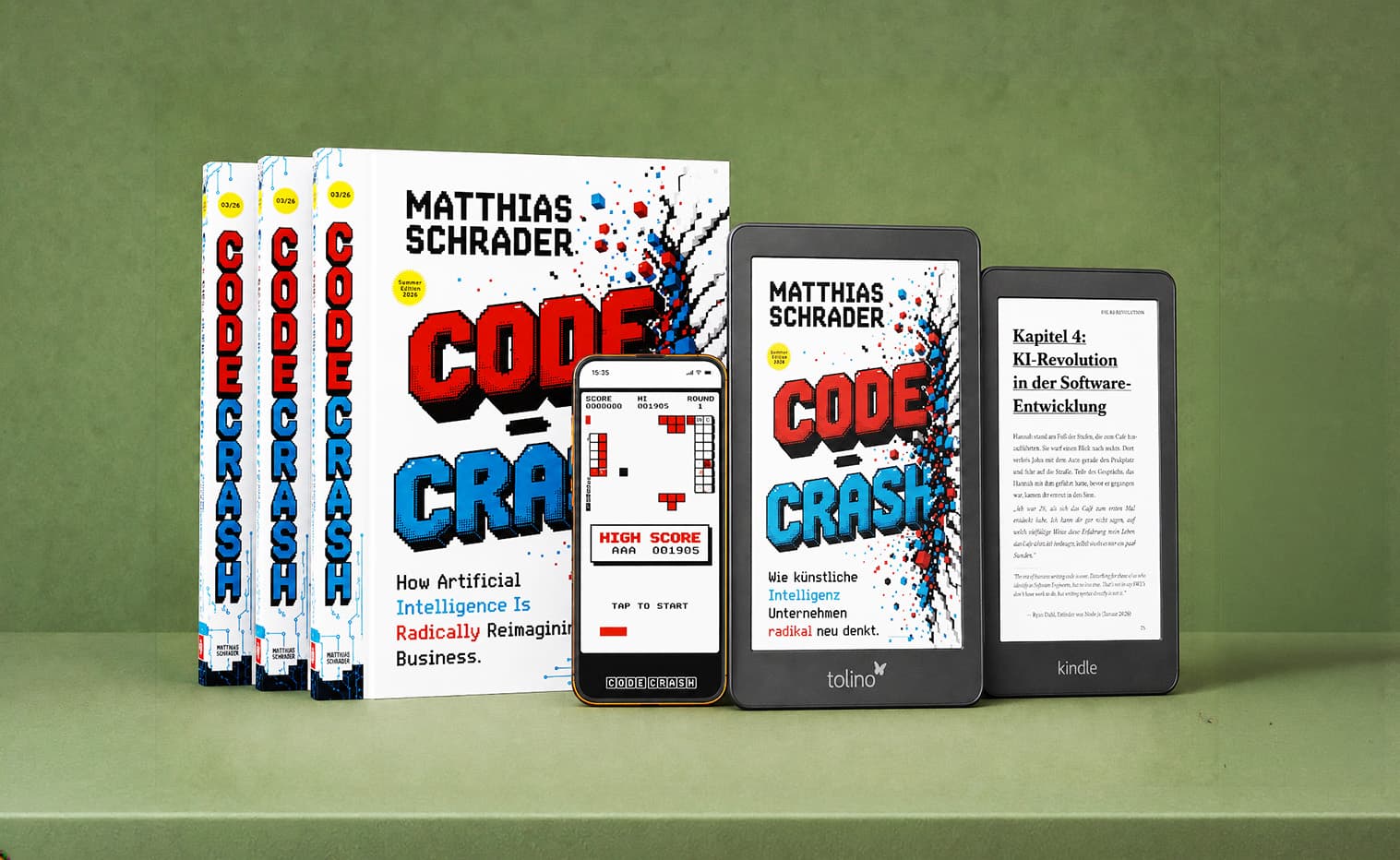
Code Crash: How AI Broke Software's Oldest Bottleneck
It's late in a Hamburg office. Most windows on the screen are stacked over a single forgotten terminal. Earlier that evening Matthias Schrader had fired off a lazy, almost hostile prompt: take RAIDAR, the firm's LLM-analytics platform, hundreds of thousands of lines of code, and clean the whole thing up. Make it safer and more robust, and don't change how it behaves for users. A few months earlier a prompt like that would have shredded any codebase alive. By morning the terminal had reported back. The code was 40 percent smaller. The large modules were restructured and cleanly rebuilt. Dozens of security issues were found and fixed. The documentation was rewritten. Everything was tested, and since it all ran green, it was already deployed. Boom. He spent the whole morning working on a codebase he hadn't written a line of.
That morning is where Code Crash begins.
Rewind three years. November 2022, another late evening, a friend sends a link with one line: "Have you seen this?" Schrader types a skeptical prompt into chat.openai.com, then a harder one: judge how well the three main theses of my 2017 book have aged. The answer comes back sharper than he could have put it himself. Five days after launch, ChatGPT had a million users; two months later it crossed a hundred million, the fastest adoption of anything in history. Back then the machine could think. That night in Hamburg, it could build. ChatGPT was the pilot. This is the series.
The hard part of software was always the same: turning a clear intent into working code. Ideas were cheap and design was cheap; the translation into software was the wall. For twenty years the whole industry organized itself around that wall. Agile promised smaller batches. SAFe promised scale. Offshoring promised cheaper hands. Each one wrapped the bottleneck in more process, and the bottleneck stayed. Agentic AI removed it. When the machine writes the code and a human verifies it works, the wall that everyone had been running into for two decades quietly disappears.
So the equation flips. Code used to be expensive and intent cheap; now code is cheap and intent expensive. The scarce good is knowing what to build and why. A single product engineer with the right tools ships what used to take a team weeks, so the capacity to produce has exploded. What stays hard is the judgment about which of a thousand possible things is worth producing at all.
Cheaper building doesn't mean less building. In 1865 the economist William Stanley Jevons watched a more efficient steam engine burn more coal, because efficiency made new uses worthwhile. Software is living through its own Jevons moment. Schrader calls the result toolflation: once building costs almost nothing, tools and products multiply faster than anyone can use them, maintain them, or tell them apart. Building gets easier and standing out gets harder in the same breath. When everyone can build, the what matters more than the how, and the spark that makes a product transformational becomes the whole game.
Every technology wave has winners and losers, and this one is no exception. The winners are the usual ones: small, fast, autonomous teams with clear ownership, close to the decision. The losers are the coordination class, the layers of management whose jobs exist to handle the complexity that other layers of management create. AI is pulling the foundation out from under that pyramid.
Schrader's answer is a triad he treats as a posture, a way of deciding what deserves to exist at all: Soul, System, Speed. Soul is the judgment and taste that separate a product from a commodity. System is the engineering discipline (architecture, testing, security, observability) that agentic tools still won't hand you for free. Speed comes from collapsing the pipeline, compressing idea to shipped product into four moves: Perceive, Prompt, Produce, Pitch.
In 2017 Schrader wrote Transformational Products, which became a classic of digital product development and described how digital products were remaking behavior, companies, and markets. Code Crash turns the same lens on product development itself. The through-line holds: user-centricity, trying and learning, people over process, outcome over output. Those principles were right in 2017 and stay right in 2026. What changes is everything around them: the speed, the roles, the shape of the organization.
The book runs in four parts, following the same vector from a single line of code out to the company, the economy, and the question of where Germany and Europe actually stand: the new context, the new bottleneck, the agentic operating model, and the next renaissance. If one sentence survives the read, it's this: the bottleneck in building digital products has moved from code to intent, and that shift sets off second-order effects far larger than the efficiency gains everyone measured first. The wall is gone. The only question left is what you'll build now that it is.
Code Crash is updated regularly at codecrash.ai.

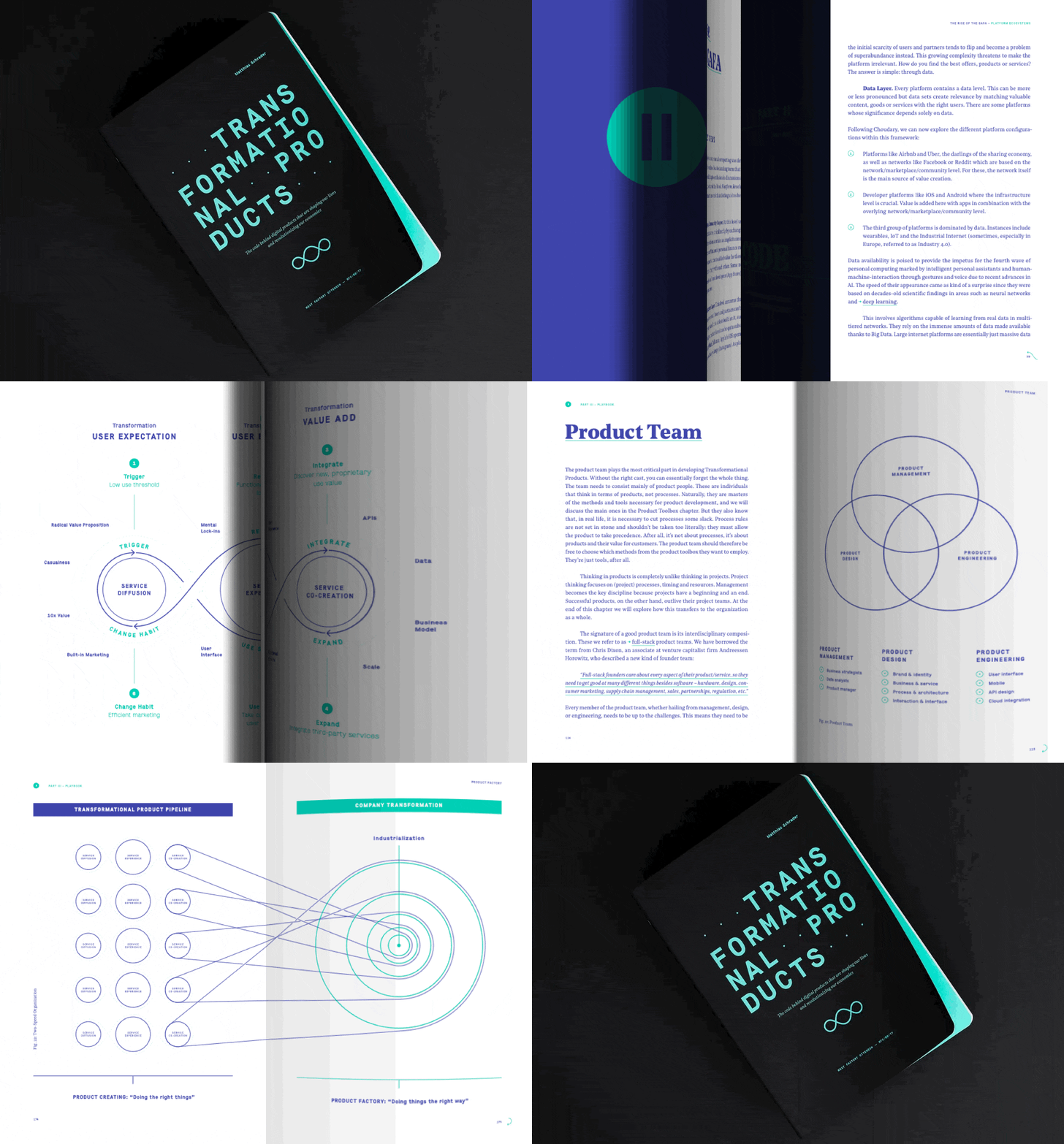
The Code of Casualness: How Digital Products Ate the World
The air smells faintly of burnt coffee and the faint hum of servers. Somewhere, in a nondescript office in Hamburg Ottensen, Matthias Schrader is typing away, chronicling the rise of the machines—not the Terminator kind, but the ones that fit snugly in your pocket and whisper sweet nothings into your ear. The machines that have turned our lives into a series of Kodak moments, except Kodak is dead, and the moments are now Instagram stories.
Schrader, a digital pioneer who survived the dot-com bubble with his company, SinnerSchrader, has seen it all. From the early days of dial-up modems and Commodore 64s to the sleek, always-on world of iPhones and AI, he’s been there, coding, consulting, and occasionally cursing the pace of change. His book, Transformational Products, is less a manual and more a eulogy for the analog world, a love letter to the digital revolution that has reshaped everything from how we shop to how we think.
The story begins, as all good stories do, with a prophecy. George Orwell’s 1984 looms large, not as a dystopian warning, but as a starting point. In 1984, Schrader was online for the first time, connecting his Commodore 64 to another machine via a jury-rigged acoustic coupler. It was clunky, slow, and utterly magical. Fast forward to today, and we’re all online all the time. Screens and algorithms mediate our lives. Once a novelty, the internet is now the world’s most incredible convenience machine, a behemoth that has swallowed industries whole and spat them out as apps.
But how did we get here? Schrader traces the rise of the Casual Economy—a term that sounds like something you’d hear in a Silicon Valley pitch deck but is, in fact, a helpful framework for understanding the digital age. It began with the personal computer, a machine from a hobbyist toy to an office essential in a few decades. Then came the web, which turned the PC into a portal to a new world of commerce and communication. And now, we’re in the mobile age, where the smartphone is not just a device but an extension of ourselves, a remote control for life itself.
The Casual Economy is built on a simple premise: convenience is king. The companies that dominate it—Google, Apple, Facebook, Amazon (GAFA)—have mastered the art of making the complex seem simple. They’ve turned products into services, services into experiences, and experiences into habits. And they’ve done it all by leveraging the power of code, the invisible force that underpins everything from your morning coffee order to your late-night Netflix binge.
But code is more than just lines of text. It’s a language, a logic, a way of thinking. Schrader argues that the most successful digital products are transformational—they don’t just solve problems; they change how we live. Take Uber, for example. It’s not just a better way to hail a cab; it’s a new way of thinking about mobility that challenges the idea of car ownership. Or consider Spotify, which has turned music from a product into a service, a never-ending stream of songs tailored to your mood, moment, and life.
A power shift has accompanied the rise of these transformational products. In the analog world, scarcity was the rule. Products were finite, and value was tied to their physical form. In the digital world, scarcity has been replaced by abundance. The cost of distributing and reproducing digital goods is zero, meaning the old rules no longer apply. The new currency is attention, and the winners are the companies that can capture, hold, and monetize it.
This shift has profound implications for businesses. Those who try to cling to old models—selling physical goods in a digital world—are doomed to fail. The future belongs to those who can embrace the logic of the Casual Economy, creating products that are not just helpful but essential, not just convenient but transformative.
Schrader’s book is a call to arms for anyone navigating this new world. It’s a guide to the code that underpins the digital age, a roadmap for building products that matter. But it’s also a warning. The Casual Economy is not without its dark side. The same forces that have made our lives easier have made them more precarious. The companies that dominate the digital landscape are not just providers of services; they are gatekeepers of information, arbiters of truth, and architects of our digital selves.
As we hurtle into the future, remembering that the code that powers our world is not neutral is worth remembering. It reflects the values and priorities of those who write it. And if we’re not careful, it could end up writing us.
So, what’s next? Schrader doesn’t have all the answers, but he does have a vision. The next wave of the digital revolution will be driven by artificial intelligence (AI). These technologies promise to make our lives even more convenient but raise new questions about privacy, autonomy, and control.
Ultimately, Transformational Products is not just a book about technology but about us. It’s a reminder that the digital age does not happen to us; it’s something we create, one line of code at a time. And if we want to shape it for the better, we need to understand the forces that drive it.
The code is out there. The question is, what will we do with it?
The book is available — beautifully printed! — on Amazon (English|German) or as a PDF download here (English|German).